


Every dry‑type transformer has a thermal limit, and in my experience most heat‑related failures start the same way: not enough air moving across the windings. Cooling fans look like an accessory bolted onto the side of the enclosure. In practice, they decide how long the transformer lasts.
Three types of fan cover almost everything sold for this job, and they are not interchangeable. What follows is where each one fits, and how to size one for your transformer. If you are specifying a fan for the first time, the selection section near the end is the part worth reading twice.

Why transformer cooling matters more than it looks
A transformer generates heat whenever it is energised. The core produces no‑load loss, the windings produce load loss, and all of that energy ends up as heat that has to go somewhere.
Oil‑immersed transformers have an advantage here: the oil carries heat away from the windings to the radiators. Dry‑type transformers do not have that path. They rely entirely on air, and air is a poor conductor of heat. In a sealed switchgear room or a basement with no real ventilation, heat simply accumulates until the winding temperature climbs past its insulation limit.
Insulation is rated by class: Class F is typically rated around 155 °C and Class H around 180 °C. Thermal aging roughly doubles for every 6 to 8 °C of sustained overtemperature. Run a transformer 10 °C above its rated winding temperature and you are not taking a small risk, you are cutting its service life by roughly half.
This is why transformer cooling fans are not a commodity accessory. They are the component that keeps winding temperature inside the class limit, and their selection determines whether a transformer reaches 20 years or fails at 8.
The three main types of transformer cooling fans
Almost every fan you will see specified for transformer cooling falls into one of three categories. They are not interchangeable, and choosing the wrong type is one of the most common specification mistakes.
Axial flow fans
Air enters and leaves along the same axis as the impeller, moving in a straight line. Axial fans move a high volume of air for their size and cost, and they are the traditional choice for oil‑immersed transformer radiators and open outdoor installations.
Their weakness is distribution. An axial fan delivers a concentrated stream, so airflow is strongest directly in front of the blades and weaker at the edges. On a long, narrow dry‑type winding this creates uneven cooling and local hot spots. They are also loud for the air they move, which is why quiet sites tend to reject them.


Centrifugal fans

Centrifugal fans draw air in along the axis and push it out radially at 90 degrees. That change of direction generates much higher static pressure, which is exactly what you need when air has to travel through a duct, a filter, a narrow enclosure, or a radiator bank with significant resistance.
The trade‑offs are noise and installation complexity. Centrifugal units are generally louder than axial or cross‑flow fans at comparable airflow, and they usually require duct design and more careful mounting. In dusty or corrosive industrial environments, though, their enclosed construction and higher pressure often make them the only workable option.
Cross‑flow fans
A cross‑flow fan, also called a tangential fan, uses a long cylindrical impeller with blades arranged in a spiral. Air is drawn in at the bottom, passes through the impeller, and is pushed out sideways across the full width of the fan.
For dry‑type transformers this is usually the best match. The windings are long and narrow, so an airflow that covers the entire length rather than a single spot is what you want. A cross‑flow fan produces a wide, uniform air curtain that sweeps the whole winding surface, which eliminates the hot spots an axial fan leaves behind.
Modern cross‑flow units for dry‑type transformers generally use EC motors: more efficient than shaded‑pole motors, quieter, and capable of continuous operation. Noise can be held to 40 dB(A) or lower on well‑designed models, which is why they dominate installations in data centres, hospitals, commercial buildings and residential areas.


Comparison at a glance
| Axial flow fan | Centrifugal fan | Cross‑flow fan | |
|---|---|---|---|
| Air direction | Along the axis | In axially, out radially | Perpendicular to the impeller axis |
| Airflow pattern | Concentrated stream | High pressure, narrow | Wide, uniform curtain |
| Static pressure | Low to medium | High | Medium |
| Noise | Medium to high | High | Low (40 dB(A) or below on quiet models) |
| Best fit | Oil‑immersed radiators, open outdoor sites | Long ducts, dusty or enclosed environments | Dry‑type transformers, noise‑sensitive sites, tight spaces |
| Typical limitation | Uneven coverage, hot spots | Louder, needs duct design | Lower peak pressure than centrifugal |
Where transformer cooling fans are used
The pattern is consistent: wherever a transformer is enclosed, heavily loaded, and expensive to shut down.
Residential blocks and shopping centres use dry‑type transformers because there is no oil to contain and nothing to burn. The rooms they sit in are usually small and badly ventilated, which is the worst combination for heat.
A hospital or a metro system cannot afford downtime, and both usually carry a noise limit on top. Data centres and EV chargers run high continuous loads in tight enclosures. Industrial plants push furnace and rectifier transformers hard. Solar and storage sites add temperature swings and humidity into the mix.
In most of these cases the same combination shows up: a dry‑type transformer, limited space, a noise ceiling, and no tolerance for an unplanned outage.
How to select the right transformer cooling fan?
Selection is usually treated as a catalogue lookup, which is how projects end up with either too little cooling or far more fan noise than the site allows. Work through these five steps instead.
Work out the airflow you need
Start from the heat that has to be removed, not from the transformer rating alone. Total loss is the no‑load loss plus the load loss at your expected load factor, and the airflow needed is:
Q = P_loss ÷ (ρ × c × ΔT)
Where P_loss is the heat to be removed in watts, ρ is air density (about 1.2 kg/m³), c is the specific heat of air (about 1005 J/kg·K), and ΔT is the temperature rise you are willing to accept across the fan, typically 10 to 15 K.
As a practical shortcut, a single GFDD590‑150 class cross‑flow fan covers roughly 500 to 800 kVA of dry‑type transformer capacity, depending on the load profile and how well the room is ventilated. A 1000 kVA unit in a warm, poorly ventilated room generally needs three fans rather than two. Always size for the worst case, not the average.
01
Look at the installation space
Measure the winding length and the clearance around it before choosing a type. Long, narrow windings and confined cabinets point to cross‑flow fans that mount flush and cover the full length. Long duct runs or high‑resistance paths point to centrifugal units. Open outdoor installations with radiators can stay with axial fans.
02
Set your noise ceiling
Noise is the constraint that most often gets ignored until a resident complains. As a working guide: residential and hospital areas generally need 40 dB(A) or lower at the point of installation, commercial buildings are usually comfortable up to 50 dB(A), and industrial sites can accept 55 to 60 dB(A). Cross‑flow transformer cooling fans are the usual answer below 45 dB(A).
03
Check the environment
Fan specifications should cover the actual site conditions: operating temperature range (a good industrial fan covers ‑40 °C to 75 °C), protection rating (IP55 for dusty or humid locations), corrosion resistance for coastal and chemical environments, and bearing quality for continuous duty. For dusty sites, an electrophoretic coating on the impeller makes cleaning far easier.
04
Match the control system
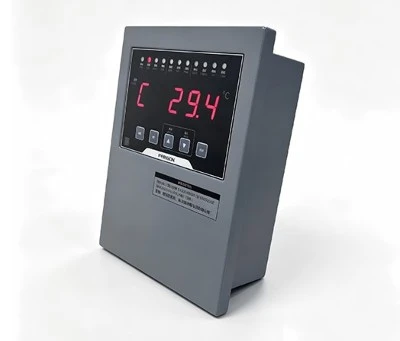
A cooling fan without proper control runs at full speed all day, which wastes electricity and generates avoidable noise. The standard approach is three‑stage control driven by a temperature controller connected to a Pt100 sensor in the winding:
Below 40 °C: fans stop
40 to 60 °C: low‑speed steady operation
Above 60 °C: high‑speed cooling
Add RS485 with Modbus if you want winding temperature and fan status visible remotely. On unattended sites this replaces the daily site walk entirely.
05
Common selection mistakes
Sizing from the transformer rating alone. Two transformers of the same kVA can have very different loss figures. Start from the actual losses and the ventilation of the room.
A common sight in older distribution rooms: fans that have been running since the day the transformer was commissioned, and windings that are still too hot because the airflow never reached them.
Buying on airflow and ignoring static pressure. A fan rated at 1300 m³/h delivers far less once it has to push through a restricted cabinet. Static pressure determines the real airflow in your installation.
Ignoring the noise limit until after installation. Once fans are mounted in a residential distribution room, reducing noise means changing the product, not adjusting the setup.
Running fans continuously. Cooling matters when the transformer is hot, and at no other time. A fan that spins all day wears out early and burns electricity for nothing.
Forgetting maintenance access. Fans that cannot be reached for cleaning and inspection will not stay efficient for 50,000 hours.


FAQ
Q: How many transformer cooling fans does one dry-type transformer need ?
A: It depends on the loss figure, the load factor and the room. As a working estimate, one cross-flow fan in the GFDD590-150 class covers roughly 500 to 800 kVA. A 1000 kVA transformer in a poorly ventilated room typically needs three units. Undersizing shows up as persistent high winding temperature under load.
Q: What is the difference between a cross-flow fan and an axial fan for transformers ?
A: An axial fan pushes air in a concentrated stream along its axis, so airflow is strongest at one point. A cross-flow fan uses a long cylindrical impeller to produce a wide, uniform curtain across the full winding length. On dry-type transformers with long windings, the cross-flow design avoids the local hot spots an axial fan leaves behind, and it is considerably quieter.
Q: Do I need a temperature controller with the transformer cooling fans ?
A: You can run fans manually. The running cost and noise penalty are the reason most people don't. A controller with a Pt100 winding sensor starts and stops fans automatically, typically with a three-stage profile, and most models add overtemperature alarm and trip outputs. It is the cheapest part of the system and the one that pays for itself fastest.
Q: Can cooling fans be retrofitted to an existing transformer ?
A: In most cases yes, provided there is mounting space around the windings and the transformer has a temperature sensor or can accept one. Cross-flow fans are usually the easiest retrofit because they mount flush and need no ductwork. Where existing fans are already installed, replacing shaded-pole motor units with EC motor versions often cuts power consumption by 40 to 50 percent at the same airflow.
Q: What noise level should I expect from a transformer cooling fan ?
A: A quality cross-flow fan for dry-type transformers runs at 40 dB(A) or below, comparable to a library. Axial fans typically fall between 45 and 60 dB(A), and centrifugal fans can be higher. If the installation is near housing, specify on noise first and airflow second.
About Perigon, and how to reach us
I'm YOUNG. Perigon Intelligent (Shanghai) Limited is based at 9 Jianding Road, Fengjing Town, Jinshan, Shanghai. We are a China‑based manufacturer of transformer temperature controllers and cooling fans, and we supply both as a matched set.

If you are working through a fan selection, these pages cover the product families mentioned above:
- Dry Type Transformer Cooling Fans
- Cross Flow Cooling Fan
- Low Noise Axial Flow Fan
- Transformer Temperature Controller
- Learn More
To get a selection proposal, send us the transformer rating, loss figure, installation environment and any noise limit through our Contact Us page.
And if anything in this guide does not match what you see on site, tell me. I would rather be corrected than keep repeating it.