


Fans: Selection Guide

GFDD series cross-flow cooling fan for dry type transformers
Dry type transformers are everywhere now: commercial buildings, factories, data centres, wind and solar sites. No oil means no fire risk, and that is usually the reason they get written into a specification. Cooling is what gets lost in the swap. Take the oil away and the windings have to shed heat into air, which they will not do on their own once load comes on. This guide is about choosing a fan that genuinely fits the job: the two fan types, the numbers that decide the choice, how airflow gets worked out, and the errors that keep turning up in the enquiries we receive.
What a dry type transformer cooling fan actually does
Strip the name back and the device is simple. A fan sits at the base of the windings, or on the coil and radiator assembly, and keeps air moving across the winding surface. Heat leaves the coils. Temperature rise stays inside the limit the insulation class allows. Three things pull against each other while that is being set up:
- Airflow and static pressure. Enough air has to reach the coil, and it has to beat the resistance of the coil, the enclosure and any ducting.
- Reliability over years of daily running. A transformer fan is expected to keep working for a decade, usually more.
- Noise and ingress protection. These fans normally sit inside a building with people in it, so dB(A) and IP ratings belong in the brief from the start, not bolted on later.
Why cooling deserves more attention than it usually gets
Insulation life tracks temperature
This is where every conversation with a new customer starts: insulation ages faster the hotter it runs. A workable rule of thumb is that every extra 6 to 8 °C of continuous winding temperature rise halves insulation life. A fan that is undersized, clogged with dust, or switched off because somebody found it noisy does not fail loudly. It shortens the transformer's life quietly, over years, and nobody connects the two events.
Same transformer, two ratings
Most dry type units carry both a natural-cooling (AN) and a forced-air (AF) rating. The hardware does not change; the fan is what unlocks the higher figure. On an existing installation, adding cooling is usually the cheapest way to find more usable capacity without replacing anything. It is also the first thing we look at on a retrofit enquiry.
Load profile decides the duty cycle
A transformer idling at 40% most of the day needs different airflow from one running at 90% through a production shift. Give us the real load profile and the choice gets much easier, so send that along with the rest of the data.
Two fan families cover almost everything we get asked about
 Cross-flow fan: air leaves as a wide, even curtain across the coil
Cross-flow fans, the GFDD series
Air is drawn along a long, narrow cylinder and pushed out as a wide, even curtain. That shape suits transformer coils and radiators, which are tall and flat. Spreading the air over a large area at low velocity keeps cooling even and the noise down. For indoor rooms and noise-sensitive sites, this is the type we propose first.
Axial fans
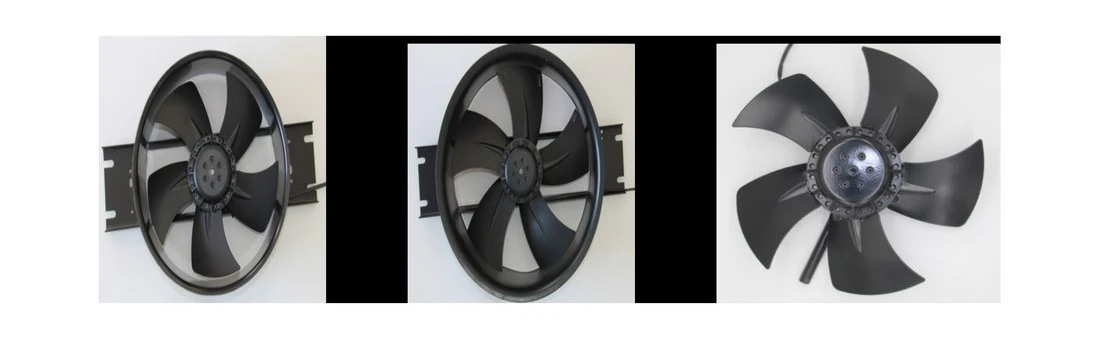
Air goes straight through the impeller, along the axis. The stream is tighter and faster, and a compact frame will handle more static pressure. On small units, end-mounted layouts and ducted paths, that is usually where we point.

Low-noise axial flow fans: compact, faster airflow
The table below settles most enquiries. Send the transformer data and the answer is usually obvious within a few minutes.
| Selection point | Cross-flow fan (GFDD) | Axial flow fan |
|---|---|---|
| Airflow pattern | Wide, even curtain over a large face | Concentrated stream along the axis |
| Suits | Coils and radiators, indoor rooms, noise-sensitive sites | Compact units, ducted or end-mounted paths |
| Noise | Low and even, easier to keep inside indoor limits | Moderate, depends on speed and mounting |
| Static pressure | Moderate | Higher from a compact frame |
| Mounting | Under the coil or radiator, full width | Side or end mounting, localised |
Numbers worth collecting before ordering
- Airflow. Start from the heat that has to leave the transformer, not from the fan that happens to be fitted now.
- Static pressure. Coil fins, enclosures and ducting all push back. Pick on airflow alone and the installed fan moves far less air than the datasheet promises. This is the sizing mistake we see most often.
- Voltage and frequency. Check the supply that exists, not the one assumed: 220 or 380 V AC, 50 or 60 Hz, or 24 V DC where the fan runs off a control circuit. Export orders are frequently 60 Hz.
- Noise, in dB(A). Measured where people actually are. Hospitals, offices and residential substations normally need the low-speed cross-flow route.
- Environment. IP rating, ambient temperature, humidity, dust. Coastal and outdoor locations call for more than a standard indoor fan offers.
- Bearing and motor life. We quote a number of hours rather than a phrase like long life, and the bearings are rated for continuous duty.
- Mounting and clearance. The fan has to fit the coil width and still leave room to draw air in and push it out. Air that cannot get in cannot get out.
Impeller and motor assembly: bearing grade decides how long a fan survives
How a selection comes together
- Collect the transformer data: rating in kVA, losses, insulation class, AN or AF, coil dimensions, clearances.
- Work out the airflow the heat load requires.
- Estimate the system resistance, meaning coil, enclosure and ducting losses, to get the static pressure the fan has to work against.
- Confirm the supply: voltage, frequency, phase, and whether the fan runs from the transformer or a separate control circuit.
- Apply the site constraints: noise limit, IP requirement, ambient temperature, and the space that actually exists.
- Check the mounting against the coil or radiator width, and make sure nothing obstructs intake or discharge.
- Test before shipping. Airflow, noise and temperature-rise data, plus a run test on every unit.
 Run test on the line, unit by unit, before packing
Where selections usually go wrong
- Airflow without static pressure. The fan under-delivers exactly where it matters, at the coil.
- A 50 Hz fan on a 60 Hz supply. It runs faster, louder and draws more current.
- Noise treated as a retrofit problem. Sorting it out later costs more than choosing the right fan at the start.
- Blocked intake or discharge. Cables, trunking, even a closed enclosure door will cut effective airflow hard.
- No access for cleaning. A fan that cannot be cleaned loses airflow to dust within a couple of seasons.
- Price-only buying with no test data. A cheap fan with no airflow curve gets expensive the moment a transformer derates.
Installation and maintenance: the notes we hand over at commissioning
 Sheet metal, assembly and testing, all in our own plant
- Mount so the airflow across the coil is symmetrical, and keep one unit from blowing hot air into the intake of the next.
- Torque the fixings to spec and check for vibration in the first hours of running.
- Set a cleaning interval from the site's dust level instead of defaulting to once a year.
- Log current draw at commissioning. A rising trend is the earliest warning that a bearing is on its way out.
- Keep one spare for critical units. Downtime is capped by whatever is already on the shelf.
We are a China supplier of dry type transformer cooling fans
Perigon Intelligent (Shanghai) Limited is a manufacturer based in Jinshan, Shanghai. We build dry type transformer cooling fans: GFDD cross-flow cooling fans, low-noise axial flow fans, and transformer temperature controllers. Most customers are dry type transformer builders, switchgear manufacturers and project contractors outside China. Sheet metal forming, assembly and run-testing all happen in our own plant, and custom voltage, frequency and non-standard dimensions are routine on export orders.
Want the details? Learn more → or go to Contact Us and leave an inquiry with your transformer rating, required airflow and mounting dimensions. An engineer will come back with a recommended model.
Learn more → Contact us / Leave an inquiry
Product pages: Dry type transformer cooling fans · GFDD cross-flow cooling fan · Low-noise axial flow fan · Transformer temperature controller
Perigon Intelligent (Shanghai) Limited · Jinshan District, Shanghai, China · Dry type transformer cooling fans, cross-flow cooling fans (GFDD series), low-noise axial flow fans and transformer temperature controllers.
These notes reflect how fans are selected here, and are meant as general guidance. Final selection should be checked against your transformer data sheet and the conditions on site.